
Hello, 4A families!
“Go into all the world and preach the gospel to all creation.” – Mark 16:15
In the coming weeks, our class will be working on a special Bible project: each student will be supported in writing and sharing a short “mini-sermon” based on a Bible story of his/her choosing.
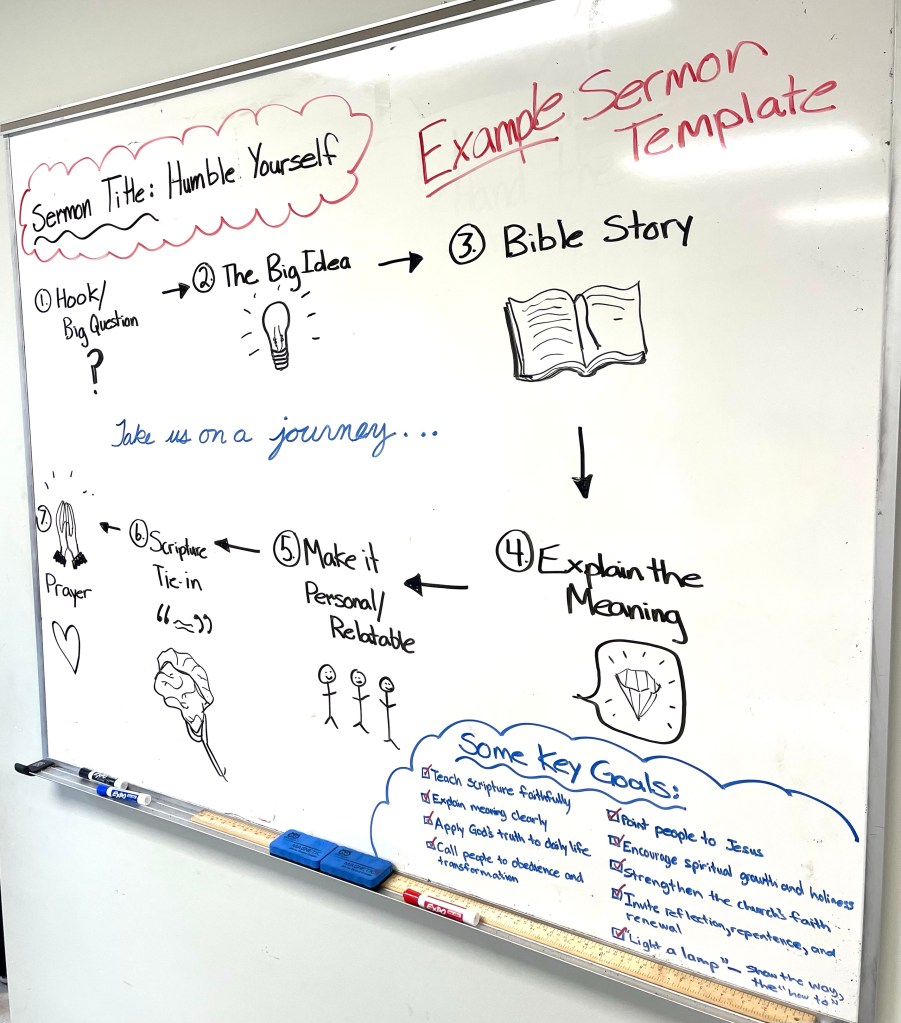
This assignment is about helping students grow in their understanding of Scripture and learn how to communicate a Bible-based message clearly and meaningfully.
A “sermon” format we will focus on is a familiar and effective structure for organizing ideas—moving from introduction, to story, to meaning, to application.
Working through this project supports the development of important skills for faith development, writing, speaking, and thoughtful communication.
I want to acknowledge that families hold a range of perspectives on preaching and teaching roles within the church. This assignment is not intended to position students in a formal preaching role.
Rather, students will be sharing their learning in a classroom setting for their peers, practicing how to thoughtfully explain a Bible story and its message.
Sharing a Bible-based teaching and reflection using a sermon-style format will support clarity and structure. I will give students extensive step-by-step support in class as we work through this process together—brainstorming, researching, organizing ideas, and practicing presentation skills.
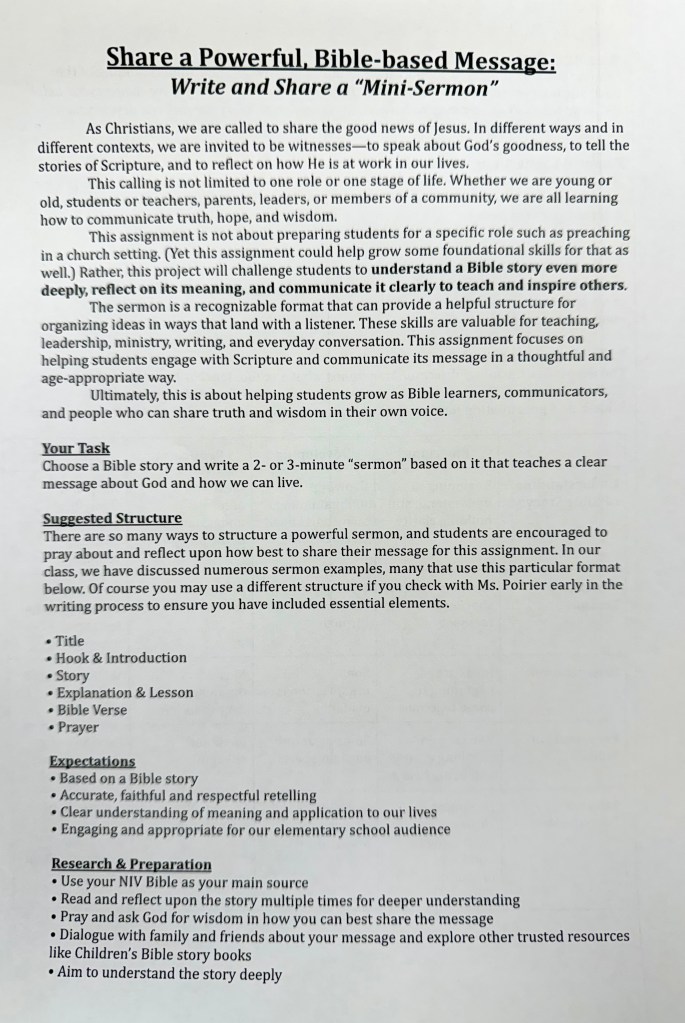
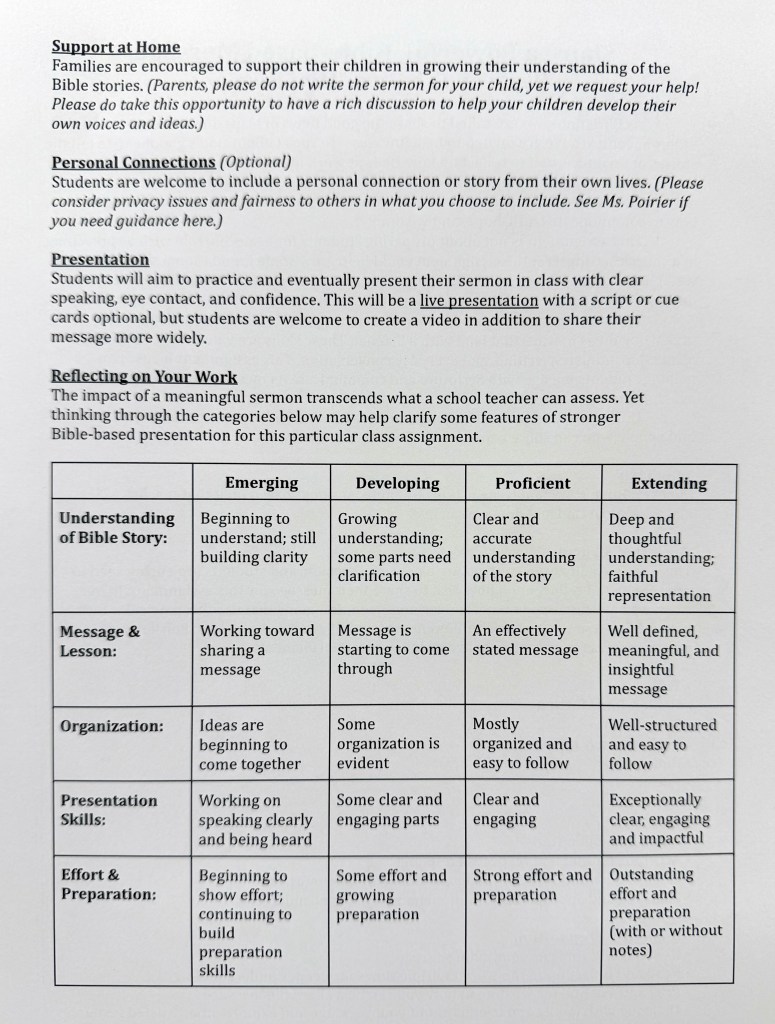
The images below show the project outline and assessment criteria that we will be using to guide our work.
That said, this learning experience becomes much richer when it is supported at home if that is your wish. I strongly encourage families to engage with your child by:
- Helping them choose a Bible story
- Talking together about what it means and why it matters
- Asking questions that deepen their thinking
- Supporting them in shaping a message they can confidently share in their own voice
Parents are their children’s first and most important teachers, and your involvement here will be incredibly valuable. Yet, if a child is ready to prepare a mini-sermon using our class format with total independence, that is great too.
Our goal is for each student to create a short presentation that reflects:
- A growing understanding of Scripture
- A clear and meaningful message
- An authentic voice and thinking
This is a beautiful opportunity for students to learn God’s Word and practice how to share it with others in thoughtful and age-appropriate ways.
“Always be prepared to give an answer to everyone who asks you to give the reason for the hope that you have.” – 1 Peter 3:15
Feel free to take a look at the attached materials below for more details about the assignment and how it will be assessed.
Thank you for your continued partnership and support.
Assignment Overview
“Mini Sermon” Structure
There are endless ways to share the Word and craft a sermon.
As preparation for teaching this unit, I took this online course on “The Art of Teaching” (Link: https://www.artofteaching.co) and was inspired by the diverse ways powerful speakers prepare and structure their Bible-based messages. This course and all of the great pastors I have learned from have helped me to refine how I share Bible lessons in our 4A class and when I teach in the children’s ministry at my church; yet I acknowledge that I am just a co-learner in this journey of sermon-writing. I will keep pointing to those who have done deeper work in creating powerful Bible teaching presentations.
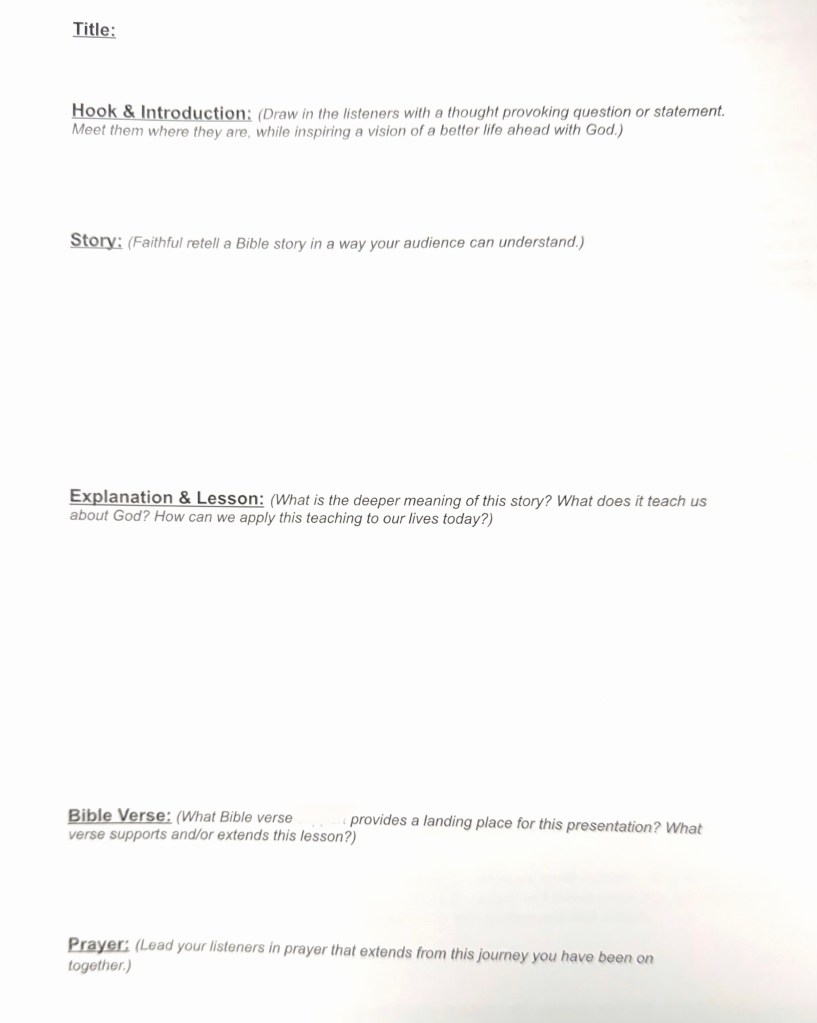
For simplicity sake, as a first step for our grade 4 project, I am asking students to follow the format below. Yet students are welcome to consult with me if they wish to shake things up. My answer will be: “Yes—AND let’s work together to make sure you still have the core elements that will help your grade 4 listeners and that you are still demonstrating the skills you have been taught in class.”
“Mini Sermon” Examples
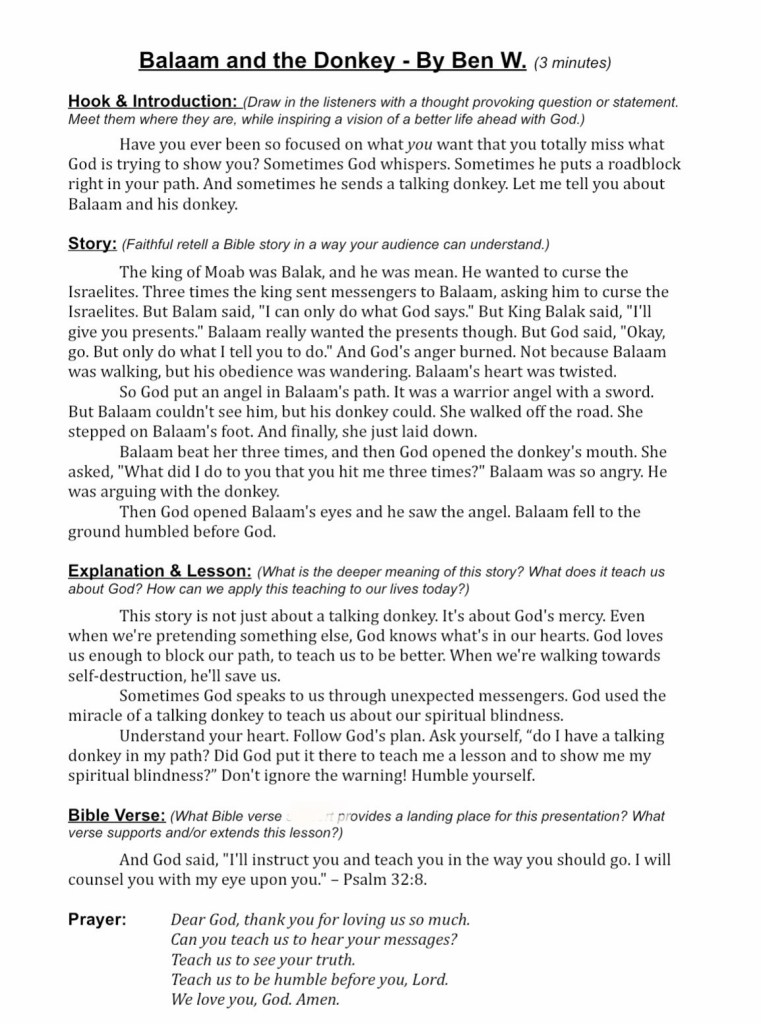
The video below shows an example of what a 3-minute “mini-sermon” could sound like…
Here is a transcript:
Q. & A.
Q: How long does it need to be?
About 2–3 minutes. We are not strictly timing, but if it goes much longer, the audience may start to lose focus. If a student has done excellent work and runs a bit longer while also speaking in an engaging way, we can certainly be flexible—but the goal is a short, clear, well-crafted message.
Q: Should it be memorized to get full marks?
No. However, the kind of practice and preparation it takes to memorize something will often help students feel more confident, more present, and more engaging—and ultimately more effective as a teacher for their audience.
Students will work toward writing a good copy of a sermon script, which they may read from. They will be encouraged, if possible, to turn that into shorter notes on a cue card to support a more natural, dynamic presentation.
Q: Can we use ChatGPT or other AI tools?
Students ask me this in class, and my answer is this: it is fair for you to have available to you the same kinds of resources that many great Bible teachers and pastors use with good judgment.
First and foremost, the Bible is your source.
Pray for guidance and wisdom in understanding your chosen Bible story, and then get to work listening to God and studying.
I do encourage students to listen to and read strong examples of sermons on their chosen Bible story and topic. They can build their understanding from those sources, but ultimately should work toward sharing an inspired message in an authentic voice. When borrowing ideas, give credit where it is due.
Many people today are able to intelligently and fairly use AI and online tools to help with research, organizing ideas, and proofreading—and that may be appropriate here with a parent’s guidance. I encourage students and families to think and pray about what will most help the student deeply understand the story, organize their thinking, and present a meaningful message.
This is a great opportunity to learn about authentic voice, good judgment, copyright, etc.
What would you rather listen to—someone reading something by generated by a robot five minutes ago, or someone sharing an inspired and well-researched message they have spent time thinking about, discussing, and praying over?
What do you hear God calling you to share?
In short, let’s keep it real, but use the tools you need that help you both learn and grow while sharing a Bible-based message with your own voice.
“If anyone speaks, they should do so as one who speaks the very words of God…” – 1 Peter 4:11
Q: Will this be marked for the report card?
This sermon project gives students opportunities to develop skills connected to our Bible course, Language Arts, and Performing Arts, and aspects of this work will be assessed accordingly.
At the same time, the larger goal is for our kids to meaningfully engage with the Bible and learn how to communicate its message in a clear, authentic, and impactful way to share the Good News.
So yes, as part of classroom learning, there will be assessment and communication about student progress. However, I’ve also been very clear with students that the ultimate measure of a sermon is not something I can fully capture on a rubric.
The deeper question is:
Was it faithful to God’s Word, and did it move hearts toward truth and action?
I love how this sermon project, which I’ve had the joy to work through with students in a previous school, invites deep learning and the invitation to transformation.
It consistently sparks rich conversations and meaningful questions that lead us back to Scripture and deeper reflection.
Thank you for joining us in praying that we would grow in using our gifts to share the good news of God’s love—His sacrifice and resurrection, the redemption He offers us, and His invitation to live and serve in His Kingdom.
Please feel free to reach out if you have any further questions.

